

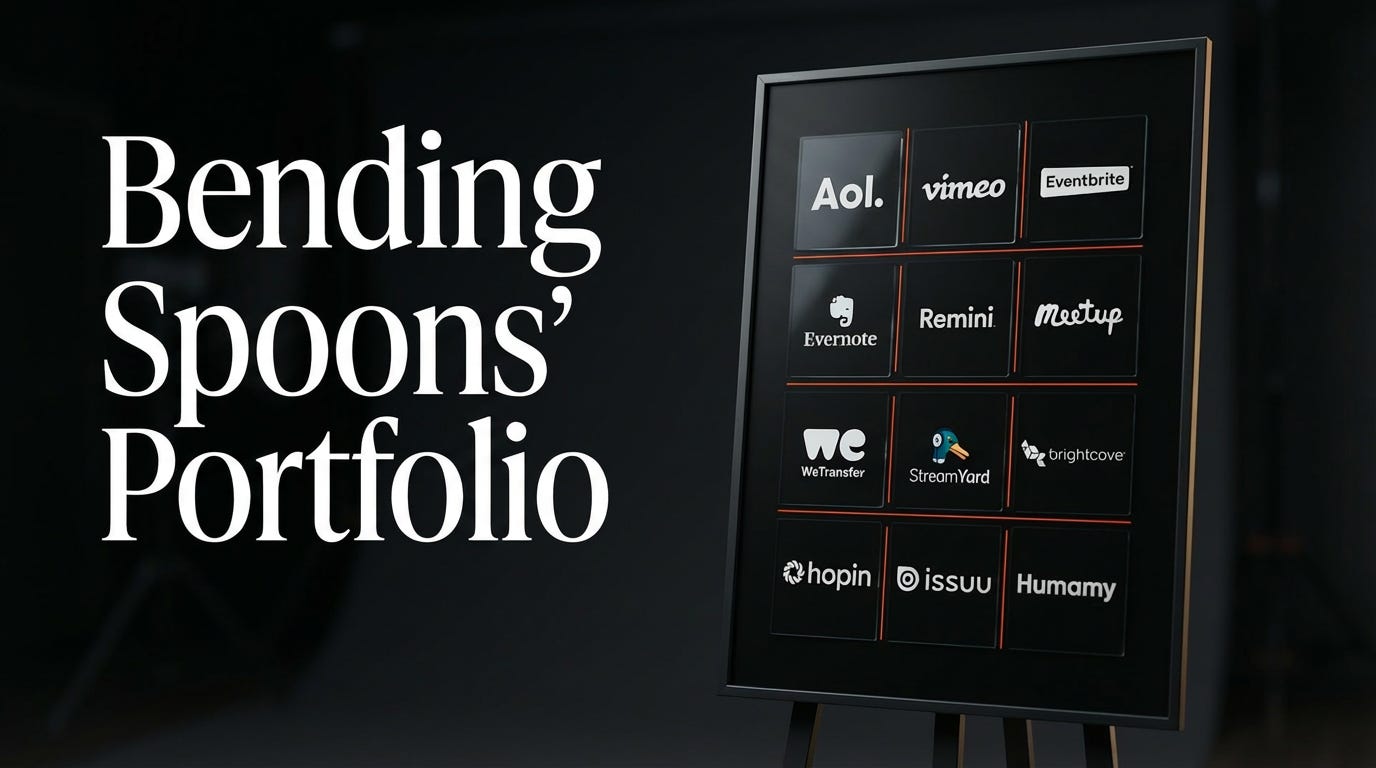
In 2025, one startup spent $3 billion acquiring Vimeo, AOL, and Eventbrite. These aren’t exactly hot companies. Why buy these “zombie” apps with stagnant growth or declining revenues?
Because this company has done it 20 times before and made them all profitable. Evernote. Meetup. WeTransfer. Remini.
This is the story of Bending Spoons.
A startup repair factory that buys companies that are dying, revives them, then holds them forever.
They’ve been profitable since day one. 1% annual employee turnover. Didn’t raise venture capital until they were making $100 million a year. All powered by an unusual playbook.
I break down the full story here
Five takeaways from Bending Spoons’ playbook:
1. Finding product-market fit is the hard part. Execution is repeatable.
Bending Spoons’ first startup crashed. They raised a million dollars, went to market, and flopped. Founder Luca Ferrari called it “arrogant to think we knew what the market would want.”
So they stopped trying to predict what people wanted, and started buying what already had product market fit. Their first acquisition was a broken keyboard app for $15,000. They fixed it. Turned a profit. Did it again.
Most founders romanticize building from scratch. Bending Spoons decided the hardest part of startups isn’t building. It’s knowing what to build. They let others take that risk, and bet they can execute better.
2. If you’re buying to hold forever, you can afford to pay more.
Most bidders model a 3-7 year exit. Bending Spoons models lifetime ownership. They never sell. Luca calls it “25% private equity, 75% tech company.”
This changes the math. When you’re capturing decades of compounding value, you can outbid everyone focused on a quick flip. That’s why Bending Spoons has never lost an acquisition bid.
3. Standardize your tools. Customize your treatment.
When Bending Spoons acquires a company, a strike team of elite operators arrives and examines four things: organizational sprawl, inefficient costs, gross margin leaks, and under-monetization.The diagnosis is usually similar, but the treatment plan is always custom.
What makes it scale is that Bending Spoons has built 50 proprietary tools to power the repair process. Strike teams plug newly acquired companies into this platform. Within days, they know what’s broken and how to fix it. Once it’s profitable, the team moves onto the next opportunity, and the tools travel with them.
4. Talent density beats talent volume.
In 2025, Bending Spoons had 800,000 applicants. They hired 250. That’s a 0.03% acceptance rate, which is harder to get into than Harvard. What’s interesting is how they keep these elite operators. There are no bonuses or equity grants. Luca believes those incentives “make things transactional.”
Instead, raises are tied to impact, and employees can convert part of their salary into stock options at a discount. The result: 1% annual turnover. Most tech companies lose 15-20% of their people every year.
A small team of exceptional people, armed with the right tools, will outperform a large team without them.
5. Debt preserves control over long-term growth. Equity can cost it.
Bending Spoons didn’t raise venture capital until they were nearly 10 years in. They bootstrapped for five years, reinvesting profits from each acquisition into the next.
When they needed capital for bigger deals, they took out loans. Banks trusted their cash flows because they’ve always been profitable.
Today they’ve raised roughly $3 billion in debt for acquisitions and $700 million in equity for operations.
Most startups raise equity early, take on zero debt, and hope they grow fast enough before the money runs out. Bending Spoons flipped the model. They scaled without giving away much control.
Hiten
=)
Transcript
Hiten: On the fifth floor, a man with glasses pops champagne. His company is now worth $1 billion. Phones around the room light up. Messages stream in from investors. “Congrats on building a rocket ship.”
Ten years later, the same man is working from home. Scrolling Reddit: “It’s so slow, it’s unusable.” “There’s so many bugs.” “I wish I switched to Notion earlier.”
He opens another tab to check financials, but Evernote hasn’t made a profit for years. He starts writing his resignation. Then an email hits his screen. It’s marked urgent. An acquisition offer from a company based in Milan.
No one on his team has heard of them, but the number is 50% higher than any other offer they’ve gotten. He accepts.
The takeover begins immediately. An Italian man fires most of the team. By noon, a new crew arrives. Europeans, fresh out of college.
Within two years, Evernote is profitable again.
But this isn’t the work of private equity. It isn’t a buy and flip, and it isn’t a one-off. It’s been done 20 times in 10 years, all by one company, across apps just like Evernote. Dying but not dead.
This is how Bending Spoons revives zombie apps at scale. By building a startup repair factory that’s been profitable since day one.
Luca Ferrari: “I remember we were making half a million a year. Now we’re making a billion.”
Hiten: But first, you quickly need to know why they don’t start from scratch. Because it unlocks the company’s entire playbook.
For Luca Ferrari and his co-founders, the insight came after their first startup failed in 2013. They raised a million dollars, went to market, and flopped.
Luca Ferrari: “We crashed and burned by being arrogant in thinking we knew what the market would want.”
Hiten: So they took the money that was left and founded Bending Spoons in 2013. Only this time, they didn’t build.
They bought a broken keyboard app for roughly $10,000, made it better, and turned a profit – used that money to buy a second app and bring it back to life, then did it over and over again.
Luca Ferrari: “We let others seek product-market fit, and then we acquire their company and try to make it even better.”
Hiten: This strategy powers the repair factory, and in 2025, it was valued at $11 billion.
So how did they go from fixing one zombie app to reviving 20 of them? What you’re about to see is Bending Spoons’ playbook.
First, let’s start with a surprising fact about the business model.
Luca Ferrari: “You know what? We have never lost a bid before.”
Hiten: How is this possible?
It’s because they see a different future than everyone else. Other buyers model an exit in three to seven years. Bending Spoons models lifetime ownership.
Luca Ferrari: “We acquired to hold forever. We never sell.”
Hiten: Luca calls this 25% private equity, 75% tech company – going deep on changes to product, engineering, and design. Decades of compounding improvements.
Luca Ferrari: “I think we’re a hybrid. It’s almost like private equity had a baby with Google.”
Hiten: This is why they sometimes pay double the next offer.
So how do they know what to buy? Acquisitions are guided by three signals.
One: Software people already love with a strong brand and loyal user base.
Two: Management is stuck and either can’t or won’t revamp the company.
Three: A clear path to profitability based on changes they would make.
Luca Ferrari: “We buy businesses where almost all the value lies in existing customers or users.”
Hiten: In other words, they execute better on what already works.
The next question is: how do they do that?
Well, once they acquire a company, it goes on the operating table. Bending Spoons sends in a strike team like an emergency medical unit. They examine the patient for four things: organizational sprawl, inefficient costs, gross margin leaks, and under-monetization.
The diagnosis is similar across acquisitions, but the treatment is almost always custom.
Luca Ferrari: “It could be rewrite the software, re-architect the cloud infrastructure, launch lots of features, redesign the UI, optimize monetization and marketing, rebuild big chunks—sometimes the entirety of the organization.”
Hiten: Here’s three examples:
At Remini, they rewrote every line of code and added features.
At Meetup, they fixed 400 bugs and cut bloat.
At WeTransfer, they reworked pricing and limited free usage.
Two things are consistent though. They improve the product for paying users, then raise prices on the core offering.
Luca Ferrari: “We’ve really focused on what these customers painfully needed.”
Hiten: The result? Retention always goes up.
But that still doesn’t explain how they make decisions at scale or move so fast.
What’s interesting is Bending Spoons doesn’t build consumer products from scratch, but they do build tools for reviving zombies.
Luca Ferrari: “More than 50 proprietary technologies, some of which could easily be sold as a B2B business—maybe worth hundreds of millions.”
Not all of them are public knowledge, but here’s what I found in my research.
Before they acquire:
Lumen converts raw data into clean insights
Crystal finds targets
After they acquire, three tools power the transformation:
Pico answers: Will users pay for this?
Minerva automates the big decisions – what to build, what to cut, and what to charge
Pantheon gives every app access to the same AI infrastructure
Strike teams simply plug newly acquired companies into this platform. Within days, they know exactly what’s broken and how to fix it. Once it’s profitable, the strike team moves on and the tools travel with them.
Luca Ferrari: “It’s so easy to allocate people to where they can create the biggest impact. That makes a ton of difference.”
Hiten: The thing is though, tools don’t revive zombie apps on their own. Elite operators do.
Talent mobility is important, but talent density is the key to the entire repair factory.
Luca Ferrari: “We think about the jobs we offer as our most important product.”
Hiten: In 2025, 800,000 people applied. They hired 250. That’s a 0.03% acceptance rate – tougher to get into than Harvard.
Here’s how they find operators worth hiring. Custom AI screens applications for potential. It also filters out people it thinks won’t handle the intense culture. Next, candidates face assessments – called harder than Google, Amazon, or Meta. It’s testing three things: talent, motivation, and problem-solving skills.
New hires start in Milan and get a document called “Controversial Principles.” Then they spend three months soaking up the culture before joining a strike team.
Luca Ferrari: “You learn faster than anywhere else. Most of our general managers run businesses—on average $50 to $100 million in revenue.”
Hiten: The compensation makes it worth their while. Bending Spoons has been described as “a little Goldman Sachs in Italy,” paying London and New York salaries in Europe.
But what’s interesting is there are no bonuses or equity grants.
Luca Ferrari: “Those kind of incentives tend to hinder relationships. They tend to make things more transactional. It’s more difficult to have a proper problem-solving session where all we’re thinking about is: how do we win together?”
Hiten: So how do they keep their elite operators? Raises are tied to impact only. There’s also a unique system for employees to build meaningful stakes.
Luca Ferrari: “Anyone can convert a portion of their compensation, up to a certain limit, to stock options at a steep discount.”
Hiten: The result of this whole thing is pretty impressive: 1% annual turnover. Most companies lose 10 to 20% of their people every year. With a team of just 700, that’s Bending Spoons’ real moat. Talent density without churn.
But none of this works without funding. Which brings me to the final page in Bending Spoons’ unusual playbook: they didn’t raise venture capital until they were nearly 10 years in.
Luca Ferrari: “We really wanted to build this with a multi-decade view, and we felt that it was quite dangerous to relinquish control so early.”
Hiten: They bootstrapped for five years, reinvesting profits from each acquisition into the next. When they were ready to go after bigger deals, they took out loans. Remember, they’ve been profitable since day one, and banks trusted their cash flows.
By the time they raised their first equity round, Bending Spoons was making $100 million in annual revenue. And investors aren’t limited to VCs. There’s a bunch of celebrities who have also bought in, including The Weeknd, Ryan Reynolds, and Andre Agassi.
Most startups raise equity early, take on zero debt, and hope they grow fast enough before the money runs out. Bending Spoons flips that model.
Today they’ve raised roughly $3 billion in debt for acquisitions and $700 million in equity for operations – all without giving away much control.
Luca Ferrari: “We can reinvest in making our platform more powerful. So build better proprietary technologies, better access to talent, and go after new, bigger acquisitions.”
Hiten: That’s how Bending Spoons revives zombie apps at scale. And according to analysts, it’s a strong match for current markets.
There’s a growing number of dead unicorns and companies trading below their IPO. Insiders say Bending Spoons has 5,000 companies on their acquisition list.
2025 was their biggest year yet—over $3 billion invested in Vimeo, AOL, and Eventbrite alone.
The deals are getting bigger, but the thesis is still the same.


