

Someone turned $500 into $50,000 betting on who would be the next pope.
Not on DraftKings. Not on FanDuel. On Kalshi — a federally regulated startup that moves more money than the entire Vegas Strip ($1B a month).
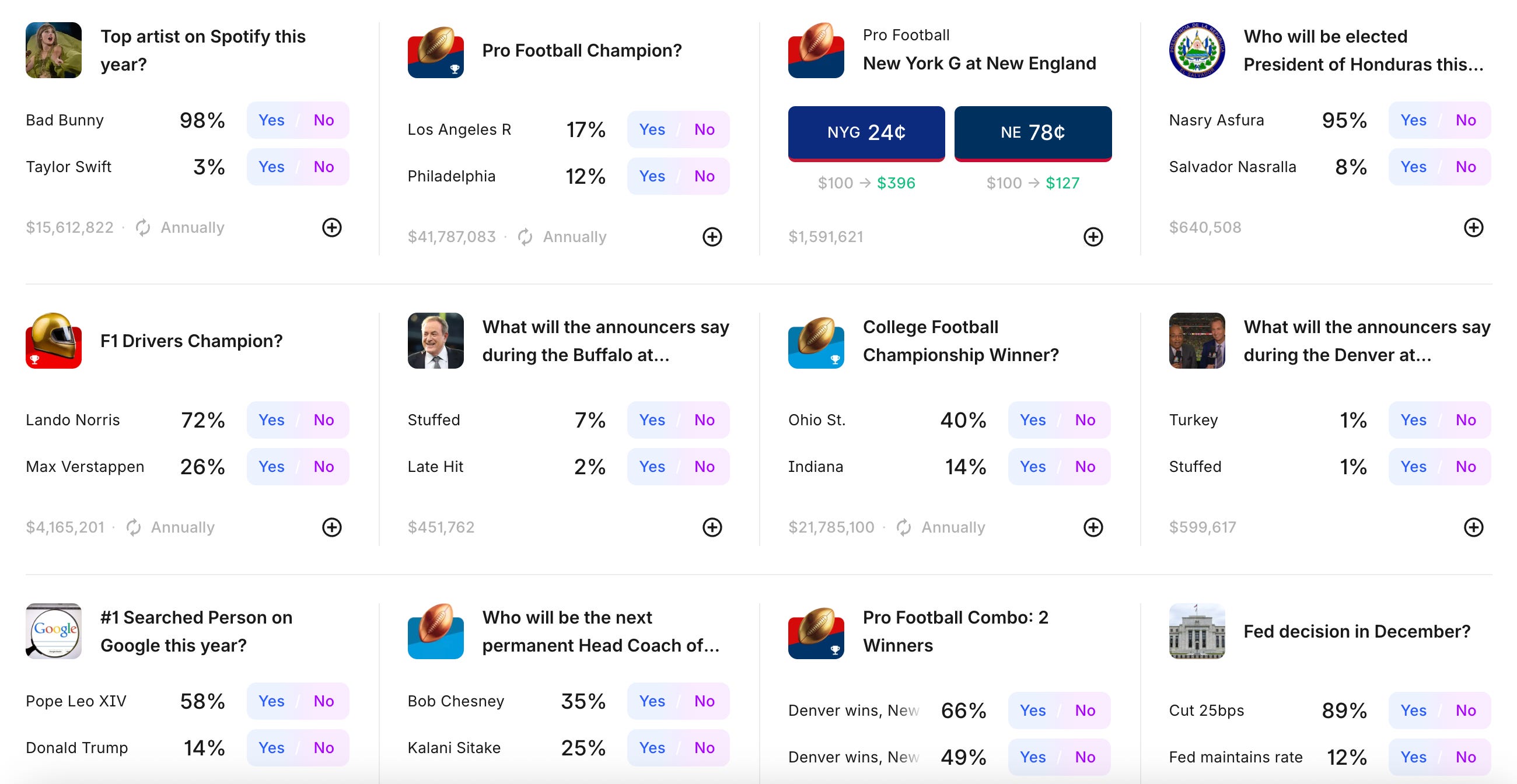
It looks like a casino. It acts like a casino. But Kalshi doesn’t have a gambling license. And that’s not the most unusual thing about it: Most startups in legal gray areas build first and fight regulators later (Uber, Airbnb, Robinhood).
Kalshi did the opposite. They spent years asking for permission before launching. Sixty-five lawyers said it was impossible. Then, in November 2020, they became the first federally approved “prediction market” in US history. Five years later, they just raised $1B at an $11B valuation.
This is how Tarek Mansour built Kalshi by optimizing for defensibility over speed — and why that bet is now being tested.
I break down the full story here
Five takeaways from Kalshi’s playbook
1. They convinced regulators when everyone said no
Sixty-five lawyers told the founders their idea was illegal. But Kalshi found a gap: the Commodity Futures Trading Commission (CFTC) had authority to define “gaming” and “wagering,” but never did. It was a legal loophole that went unnoticed for nearly a century. Over thirty meetings, they made the case that prediction markets aren’t wagering and instead measure uncertainty — similar to how traders hedge oil or gold. The CFTC agreed and awarded Kalshi a federal license in November 2020. By doing the hard thing first, Kalshi unlocked a new market (legally).
2. Why going slow created their moat
Federal approval gave Kalshi something competitors can’t replicate: legitimacy. By optimizing for defensibility over speed, Kalshi overtook Polymarket to become the dominant player in the space. As co-founder Tarek Mansour framed his early strategy: “If we want this thing to be big, we have to play by the book.” In October 2025, total trading volume passed $11B.
3. How they scaled by suing their own regulator
Kalshi’s growth isn’t linear; it’s shaped like a hockey stick. The inflection point came after the company sued their own regulator, made the same case, then won approval for political event contracts. For the first time in 100 years, it became legal to bet on elections in the US — just in time for the 2024 Presidential election. Trading volume has grown 200x since.
4. How Kalshi makes money
It’s easy to assume Kalshi operates like a casino, but legally it doesn’t. There’s no “house” taking the opposite side of your bet. Every contract matches two traders (yes and no). Kalshi then takes a small cut on every transaction, deposit, and withdrawal. The odds are set by the market, not the company. That’s why, by October 2025, Kalshi was generating roughly $13 million in monthly revenue entirely from taxing activity, not from pricing risk. And at a federal level, everything is above board (for now). By building alongside regulators, they essentially helped develop the compliance framework for their own market.
5. Why their defensibility strategy is now being tested
By October 2025, roughly 80% of trades were on sports. This is a problem for Kalshi, because states tax sports betting. Ohio, Nevada, Massachusetts, and New York are trying to stop Kalshi in their state (they want their cut). The more states that join in, the more scrutiny they face. Kalshi knows the stakes: they need their federal license to operate. That’s why Kalshi has stacked its board with former CFTC officials and gambling lobbyists (even Donald Trump Jr. as an advisor). If their license comes under threat, it’s a safe bet they will leverage those connections to protect it.
Hiten
=)
Transcript
It’s 10 p.m. on a dark, rainy Wednesday night.
In a small apartment in New York, South Park plays on the TV.
A kid in his twenties sits at a desk, his MacBook wired into a cable box.
Picking up the same episode, only 28 seconds faster.
That head start is about to make him real money.
He’s running a custom script.
Lines of code, reading the show’s captions in real time.
Online, there’s a platform letting people bet on what’s going to be said in the episode:
“Trump.” “Elon.” “Tylenol.”
As soon as one of those words appears, the code buys low, before anyone on streaming can react.
Seconds later, the prices jump.
He’s already out, cashing in on the lag between cable and the cloud.
But this isn’t some underground gambling site.
It’s a federally regulated startup backed by Wall Street and Silicon Valley.
Every month, a billion dollars flows through this platform – more than the entire Vegas Strip.
It looks like a casino.
It acts like a casino.
But Kalshi doesn’t have a gambling license.
It has something far more powerful.
In this video, I’ll break down:
How Kalshi makes money whether you win or lose
The legal loophole that keeps them alive even as states try to ban them
And the one thing that could make their house of cards collapse
But before we go further, you need to understand how a bet on Kalshi works.
Every “bet” is called an “event contract.”
It’s a yes-or-no position on something that might happen.
Like the New York City election or the Pro Football champion.
Each contract trades between 1 and 99 cents.
The price is the crowd’s odds.
For each option, Kalshi matches a trader who thinks “yes” with another who thinks “no.”
When new information hits – a poll, a touchdown, a tweet – prices move.
Then, when the event resolves, all of the money staked by the losing side funds the winners.
To make this concrete, let’s follow a single bet.
You’re betting that a South Park character says the word “Trump” in an episode.
You put down $1,000 when the price is 1 cent – 1% odds.
That gets you 100,000 “yes” contracts.
If “Trump” is said, each contract pays you a dollar.
And you walk away with a hundred grand.
If not, you lose it all.
That’s an extreme case – but it has happened.
Like when a punter put $500 on the next pope and made more than fifty grand.
Most of the time, prices land somewhere in the middle.
Say you bought in at 70 cents, and the odds drop to 40.
You could lock in a $430 loss by selling, or hold and hope it swings back.
That’s the whole machine.
A live market where people trade yes/no contracts.
And the outcome decides who gets paid.
Now that you know how Kalshi works, the question is: how do they actually make money?
Every month, roughly a billion dollars moves across the platform.
But trade volume isn’t the same as revenue.
Instead, Kalshi takes a small cut every time money changes hands – just like an online marketplace.
They charge a sliding fee on every transaction: 1 to 3.5%, depending on trade size.
There’s fixed fees as well: 2% on deposits, and a $2 withdrawal fee.
Win, lose, or just trade again – Kalshi earns every time money moves.
It’s a tax on activity, not on risk.
By my estimates, Kalshi’s pulling in about $13 million a month – roughly $160 million a year.
When this video was recorded, total trading volume passed $11 billion.
This earning mechanism is what separates Kalshi from traditional gambling.
In a casino, the house sets the odds and bakes in a tiny markup.
Every spin, roll or hand earns a few cents.
One loss doesn’t matter.
Over thousands of rounds, those cents stack into guaranteed profit.
Kalshi doesn’t do that.
There’s no house, so they have no stake in the outcome.
Remember, it’s just people trading against each other.
Knowing how Kalshi makes money differently to a casino is going to help you understand my next point:
Which is why they’re allowed to operate.
When Kalshi started, 65 lawyers told the founders the same thing:
*“*This idea isn’t new, and it’s illegal.”
So they took an unusual path for a startup.
As founder Tareck Mansoor put it:
“For this thing to be big, we need to do it by the book.”
In mid-2019, Kalshi raised a small seed round and began building.
A team of roughly ten worked on shipping the product.
But Kalshi’s breakthrough didn’t come from tech, it came from the law.
Buried in the Commodity Exchange Act is a 90-year-old clause,
giving the Commodity and Futures Trading Commission, the CFTC, power to define “gaming” and “wagering.”
But the law never actually defined those words.
That gap was Kalshi’s opening.
Over the next year, the team met more than thirty times with the CFTC.
Each meeting was part negotiation, part education – showing how Kalshi’s contracts weren’t wagers, but predictions.
They leaned on two core arguments:
One: Similar to how traders hedge gold and oil, each contract is a tool to measure uncertainty in real-world events.
Two: Kalshi has no stake in the result.
And they came armed.
Not just a demo, but binders of research.
Proposed compliance frameworks, risk models, even mock audits.
The kind of prep you’d expect from Goldman Sachs, not a ten-person startup.
Against all odds, the CFTC said yes.
In November 2020, Kalshi became the first federally approved “prediction market” in U.S. history.
But that alone doesn’t explain how they went mainstream.
Because after getting their license, platform growth slowed.
The founders knew they needed a breakout moment.
And they saw one: the US presidential election in 2024.
But they had a problem.
Kalshi never got permission to list political event contracts – meaning people couldn’t put money on who would be the next President.
So they sued their own regulator.
Kalshi made the same case from before.
Only this time, the CFTC said no.
So Kalshi took the case to federal court, and won.
For the first time in nearly a century, Americans could legally trade on political events.
The election hype put them in the spotlight, but it was just the start.
They’ve expanded beyond politics – adding sports markets and parlays.
Since October 2024 to now, trading volume has surged 200×.
But not everybody is a fan.
Several states have tried to ban Kalshi.
But all those lawsuits have failed so far.
In the U.S., both federal and state governments make laws.
When they clash, federal law wins.
It’s called preemption.
Kalshi’s founder summed it up simply:
“State laws don’t apply to us.”
But Kalshi is aware of its strategic vulnerability.
One license is keeping their business alive.
If enough states push back, Kalshi’s house of cards might not stand forever.
This brings me to their next move…
How Kalshi is protecting their license.
Since they got it, they’ve quietly built a powerful network of political and financial allies.
Brian Quinntenz, a former CFTC Commissioner, joined their board in 2021.
In 2025, they added Donald Trump Jr. as a strategic advisor.
And they brought in Sara Slane.
One of the key figures in legalizing sports betting across America.
It’s not all one-way traffic either.
Several former Kalshi employees have taken roles inside the U.S. government.
And their legal counsel, Josh Sterling, is now being vetted by the White House to lead the CFTC itself.
This could give Kalshi a direct line inside Washington.
On the financial side, Kalshi is backed by three Wall Street titans.
Charles Schwab, Henry Kravis, and Peng Zhao – whose firms collectively manage trillions.
All of this – the connections, the capital, the influence – fortifies one thing.
Their federal license.
If that license ever came under threat, it’s a safe bet Kalshi could use those connections to defend it.
Which might soon be necessary.
Remember how Kalshi is leaning hard into sports?
When they first applied for their federal license, they deliberately stayed away from sports-related contracts.
Now, in 2025, those markets make up nearly 80% of all money traded on the platform.
That’s a problem.
States that allow sports betting collect taxes from it.
For example, New York pulled in more than $1 billion in sports-betting tax revenue last year.
Guess how much Kalshi paid?
Zero.
And if there’s one thing governments hate, it’s not getting their cut.
That’s exactly why Ohio is now trying to ban Kalshi.
Ohio is the second-largest sports-betting market in the U.S.
The more states that try to tax Kalshi,
the more scrutiny it faces.
But as long as that federal license stands...
Kalshi is a casino the government can’t shut down.


